
What is Homeopathy?

Homeopathy is a system of natural health care that has been in worldwide use for over 200 years.
Homeopathy treats each person as a unique individual with the aim of stimulating their own healing ability. A homeopath selects the most appropriate medicine based on the individual’s specific symptoms and personal level of health.
It is recognised by the World Health Organisation as the second largest therapeutic system in use in the world. While it is most popular in India and South America, over thirty million people in Europe and millions of others around the world also benefit from its use.

Why is homeopathy so popular?
Many people are becoming increasingly disillusioned with the outcomes of contemporary western medicine, its many side effects, its close relationships with big pharmaceutical companies and its inability to do more than treat the results of disease.
- Homeopathic treatment works with your body’s own healing powers to bring about health and well being.
- You are treated as an individual, not as a collection of disease labels.
- Homeopathy treats all your symptoms at all levels of your being – spiritual, emotional, mental and physical and finds the ‘like cures like’ match for them.
- Homeopathically prepared remedies, providing the minimum dose, are gentle, subtle and powerful. They are non-addictive and not tested on animals.
Often the primary aim of treatment is to remove the physical symptoms. On the face of it this makes sense because symptoms may cause pain or interfere with normal functioning. Homeopathy gets to the root cause of symptoms. cause symptoms to arise in a healthy person cure them when applied in ill health?
An example of current medical wisdom is provided by the first aid treatment of burns, i.e. putting the affected part under the soothing influence of cold, running water. The heat of the burn may be temporarily extinguished. But, the healing of the burn is not aided by this. A homeopathic treatment for a burn might be to apply a cream medicated with naturally occurring substances such as Urtica urens or Cantharis, which in higher concentrations produce a reaction similar to burning. This excites a reaction within the body that mimics its usual response to a burn, thus speeding up healing. Under the action of such a medicine the sensation of burning will momentarily increase, then easing of the pain and natural healing will follow. The idea is that the body knows how best to respond and the best help we can provide is to encourage it in its healing efforts -to work with it, not against it.
The homeopathic definition of health can be covered in six words: ‘the freedom to adapt to change’. A healthy person is able to adjust freely according to changing circumstances.
The long-term aim of homeopathic treatment is not only to alleviate the immediate presenting problem, but also to address the underlying causes. A person’s susceptibility to disease can arise from psychological imbalance, stress, physical weaknesses and heredity. A well chosen homeopathic medicine strengthens a person’s self-curative response. When this is working at an optimum level the naturally protective mechanisms will follow suit.
A study in Germany followed over 3,500 chronically ill adults and children receiving routine homeopathic care from GPs over an eight-year period. At the start, 97% of participants were diagnosed with a chronic complaint and 95% declared previous conventional treatment for their condition. The study found that, “patients who seek homeopathic treatment are likely to improve considerably” and that health benefits were steady and long term.
There are more studies of this nature, especially from France, Germany and Switzerland, all countries where homeopathy is widely used.
What research is there in homeopathy?
There is sound research and evidence in homeopathy.
 For example; by the end of 2019, 221 randomised controlled trials of homeopathy on 115 different medical conditions had been published in peer-reviewed journals. Of these, 129 were placebo-controlled on 77 medical conditions and were therefore eligible for detailed review.
45% were positive, finding that homeopathy was effective; 4% were negative, finding that homeopathy was ineffective; and 51% were inconclusive.
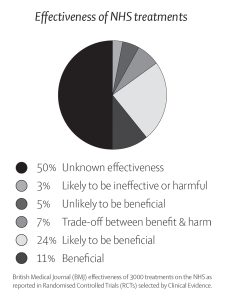
These results are surprisingly similar to the effectiveness of conventional medicine. A study printed in 2015 in the British Medical Journal (BMJ) found that of 3,000 commonly used NHS treatments 50% are of unknown effectiveness and only 11% are proven to be beneficial.
SSRI anti-depressants, such as Prozac, are an example of such a treatment. These have now been confirmed as being no more effective than placebo in the treatment of mild and moderate depression, yet in 2016 the NHS dispensed 64.7 million anti-depressant items.
Several systematic reviews and meta-analyses of homeopathy (large scale overview of all previous research) have also been carried out. However, until 2014, none had looked solely at placebo-controlled trials of individualised homeopathic treatment, as is usually delivered by homeopaths in practice.
The research team led by Dr Mathie et al. has now performed such an analysis and found that homeopathic medicines when prescribed during individualised treatment are 1.5-2.0 times more likely to have a beneficial effect than placebo. As Dr Mathie explains, when taken collectively, this programme of work reaches an “unequivocally positive result” for homeopathy.
For more facts and research about homeopathy you might like to visit: