
What is Homeopathy?

Homeopathy is a system of natural health care that has been in worldwide use for over 200 years.
Homeopathy treats each person as a unique individual with the aim of stimulating their own healing ability. A homeopath selects the most appropriate medicine based on the individual’s specific symptoms and personal level of health.
It is recognised by the World Health Organisation as the second largest therapeutic system in use in the world. While it is most popular in India and South America, over thirty million people in Europe and millions of others around the world also benefit from its use.
The name ‘homeopathy’, coined by its originator, Samuel Hahnemann, is derived from the Greek words for ‘similar suffering’ referring to the ‘like cures like’ principle of healing. Hahnemann was born in Germany two hundred and fifty years ago. At this time the old world-view was being renovated and traditional beliefs, many flimsily based upon superstition, were being increasingly subjected to the rigour of experimental scrutiny and assessment. The practice of Homeopathy is based upon science while its application is an art.

,Homeopathy is founded on two principles that have occurred regularly throughout the history of medicine, both in eastern and western worlds. The first principle of ‘like cures like’ can be looked at in several ways. One way is to assume that the body knows what it is doing and that symptoms are the body’s way of taking action to overcome illness. This healing response is automatic in living organisms; we term it the ‘vital response’. The similar medicine acts as a stimulus to the natural vital response, giving it the information it needs to complete its healing work. Since the initial action of the vital response plus the medicine is to increase the strength of the symptoms, this is our first indication of internal healing taking place, of diseases being cured from within – pushed outwards along the established routes of past and present symptoms.
Before the medicines are decided upon, their curative powers are discovered by testing them out on healthy human subjects and carefully noting emotional, mental and physical changes. This is termed a ‘proving’. This information constitutes the basis for ‘like cures like’, for a medicine’s unique symptom picture must match up with the individual’s unique expression of their disease, that is the present and persisting symptoms of the disease.
The second principle, that only ‘the minimum dose’ should be employed, is based upon the understanding that the stimulus of the medicine works from within the vitality and is not imposed from the outside. Only enough is administered to initiate the healing process, which then carries on, driven by its own internal healing mission. Homeopathic medicines given in minimum doses, while they do stimulate the body’s vital response, do not produce the gross side effects that are so often the pitfall of conventional treatment.
Why is homeopathy so popular?
- Homeopathic treatment works with your body’s own healing powers to bring about health and well being.
- You are treated as an individual, not as a collection of disease labels.
- Homeopathy treats all your symptoms at all levels of your being – spiritual, emotional, mental and physical and finds the ‘like cures like’ match for them.
- Homeopathically prepared remedies, providing the minimum dose, are gentle, subtle and powerful. They are non-addictive and not tested on animals.
Does homeopathy help people to improve their health?
Yes it does, particularly with regard to chronic, long term conditions.
For example, an observational study at the Bristol Homeopathic Hospital included over 6,500 consecutive patients with more than 23,000 attendances in a six-year period; 70% of follow up patients reported improved health, 50% reported major improvement. The largest improvements were reported in childhood eczema or asthma, and in inflammatory bowel disease, irritable bowel syndrome, menopausal problems and migraines.
Other examples: in 2018 a study in Italy observed nearly 4000 patients who were assessed before and after receiving homeopathic treatment at a clinic in Tuscany. Improvements were recorded in 88.8% of patients overall, with significant improvements seen in 68.1%. In the nearby Oncology clinic, homeopathic and integrative treatment of the adverse effects of anti-cancer therapies was effective in 89.1% of followed-up cancer patients, particularly for hot flashes, nausea, depression, asthenia and anxiety.
A study in Germany followed over 3,500 chronically ill adults and children receiving routine homeopathic care from GPs over an eight-year period. At the start, 97% of participants were diagnosed with a chronic complaint and 95% declared previous conventional treatment for their condition. The study found that, “patients who seek homeopathic treatment are likely to improve considerably” and that health benefits were steady and long term.
There are more studies of this nature, especially from France, Germany and Switzerland, all countries where homeopathy is widely used.
What research is there in homeopathy?
There is sound research and evidence in homeopathy.
 For example; by the end of 2019, 221 randomised controlled trials of homeopathy on 115 different medical conditions had been published in peer-reviewed journals. Of these, 129 were placebo-controlled on 77 medical conditions and were therefore eligible for detailed review.
45% were positive, finding that homeopathy was effective; 4% were negative, finding that homeopathy was ineffective; and 51% were inconclusive.
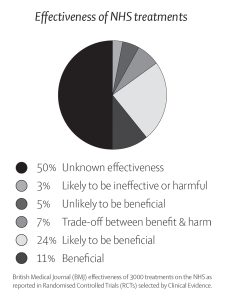
These results are surprisingly similar to the effectiveness of conventional medicine. A study printed in 2015 in the British Medical Journal (BMJ) found that of 3,000 commonly used NHS treatments 50% are of unknown effectiveness and only 11% are proven to be beneficial.
SSRI anti-depressants, such as Prozac, are an example of such a treatment. These have now been confirmed as being no more effective than placebo in the treatment of mild and moderate depression, yet in 2016 the NHS dispensed 64.7 million anti-depressant items.
Several systematic reviews and meta-analyses of homeopathy (large scale overview of all previous research) have also been carried out. However, until 2014, none had looked solely at placebo-controlled trials of individualised homeopathic treatment, as is usually delivered by homeopaths in practice.
The research team led by Dr Mathie et al. has now performed such an analysis and found that homeopathic medicines when prescribed during individualised treatment are 1.5-2.0 times more likely to have a beneficial effect than placebo. As Dr Mathie explains, when taken collectively, this programme of work reaches an “unequivocally positive result” for homeopathy.
For more facts and research about homeopathy you might like to visit: